Corporate Journey
Growing Better Balsam Inc. (GBBI) has its roots traced back to 1982 when the company’s founder introduced plant tissue culture as a top-notch method for plant multiplication. This cloning technique revolutionized plant production by enabling the creation of thousands of identical, disease-free plantlets in short propagation cycles. The widespread adoption of plant tissue culture technology across all vegetatively propagated plant species has revolutionized plant propagation practices globally.
Following a collaboration in 2017 with the Christmas Tree Council of Nova Scotia (CTCNS), Growing Better Balsam Inc. became an independent entity. GBBI embarked on a project to scale up the bench-scale propagation of Balsam Fir through Somatic Embryogenesis, transitioning this innovative process into commercial production. The current 2024 season marks the commencement of commercial production in response to this venture.
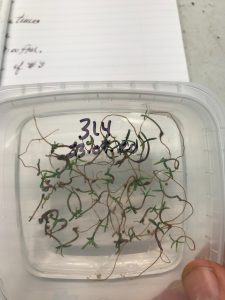
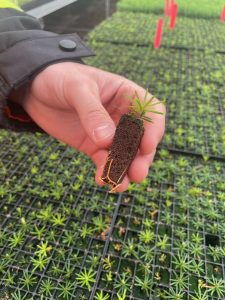
Balsam Fir (Abies balsamea), like many conifers, poses a challenge for plant propagators due to their limited vegetative propagation capabilities. To address this challenge, an alternative method called Somatic Embryogenesis has been developed for conifer propagation. This technology involves conditioning cells of developing embryos to generate callus, leading to embryo development. These identical embryos can then be germinated like seeds, resulting in the growth of numerous identical plantlets for propagation.

 .
. 
Reason and Process for Growing Better balsam Inc.:
In Nova Scotia, Christmas tree producers export trees to various international destinations. The process involves cutting trees in October, wrapping them, placing them in refrigerated containers, and shipping them to tropical areas. Upon arrival, customers unwrap the trees, causing some needles to fall off as the branches expand back to their natural shape. Unhappy with the needle loss, customers quickly contact the grower to express their dissatisfaction.
The recurring complaints prompted the exploration of methods to minimize needle loss upon delivery. One approach involved cultivating trees that naturally retain their needles, leading to the initiation of a breeding program to enhance tree quality.
Balsam Fir trees, which are conifers, are not easily propagated from vegetative cuttings. As a result, the cloning of trees through Somatic Embryogenesis was employed.
Superior trees from Nova Scotia were selected and grafted onto seedling trees in a research setting. Over several years, these grafted trees were monitored for needle retention, branch structure, internodal branching, and other traits to determine their post-harvest needle longevity.
Following a rigorous evaluation process, exceptional candidates were crossbred. The resulting pollinated flowers with developing seed embryos were then harvested. These embryonic seed tissues were cultured on growth media in sterile conditions to encourage undifferentiated cell growth, known as callus growth. Undifferentiated cells provide a flexible stage where they can develop into large cell masses or be cultivated into embryos on different growth media.
Each cell possesses the same genetic makeup and will mature into an embryo, identical to numerous others. By germinating these embryos like seeds, small seedlings are produced. While the seeds from pollinated cones share common parents, each seedling is unique, akin to siblings. Conversely, seedlings derived from callus tissues are exact replicas of one another, much like copies from a duplicating machine.
This method enables the production of thousands of high-quality trees to meet the demands of Christmas tree producers and satisfy their discerning customer base.
Ultimately, the objective is to CULTIVATE SUPERIOR BALSAM TREES.
Read more: